Recorded in Siena – 2013
Lecture 1 notes
<h1 class=”p1″><span class=”s1″><b>THE BATTLE IN THE MIND</b></span></h1>
<p class=”p2″><span class=”s1″><i>First series</i></span></p>
<p class=”p3″><span class=”s1″><b>Lesson 1</b></span></p>
<p class=”p4″><span class=”s1″><b>Strongholds, high places and bastions</b></span></p>
<p class=”p5″><span class=”s1″><i>Maurizio Tiezzi – Fondazione Cantonuovo</i></span></p>
<p class=”p7″><span class=”s1″><b>1. The spiritual battle and the theme of the mind</b></span></p>
<p class=”p8″><span class=”s1″>This series forms part of a wider programme dedicated to the kingdom of God, which focuses on a specific aspect of the spiritual struggle described in Ephesians 6: the battle waged in the mind.</span></p>
<p class=”p8″><span class=”s1″>Paul, in Ephesians 6, had already outlined the nature of the conflict and the identity of the enemy, describing the struggle — a term that authoritative English-language translators render as ‘wrestling’, a no-holds-barred fight — as something that involves every believer without exception. If one belongs to the Messiah, one is no stranger to this battle. Those who belong to the world, however, go with the flow of the larger system that governs it, and are not at war.</span></p>
<table class=”t1″ cellspacing=”0″ cellpadding=”0″>
<tbody>
<tr>
<td class=”td1″ valign=”top”>
<p class=”p9″><span class=”s2″><b>Eph 6:12–13<span class=”Apple-converted-space”> </span></b></span><span class=”s1″><i>Our struggle is not against flesh and blood, but against the principalities, the powers, against the rulers of this dark world, against the spiritual forces of evil in the heavenly realms.</i></span></p>
</td>
</tr>
</tbody>
</table>
<p class=”p11″><span class=”s1″><b>2. The key text: 2 Corinthians 10:3–5</b></span></p>
<p class=”p12″><span class=”s1″><b>2.1 Living in the world without fighting according to the world</b></span></p>
<p class=”p8″><span class=”s1″>The key passage is 2 Corinthians 10:3–5. Paul begins with a fundamental distinction: although we live in the world — that is, having a body not yet redeemed and therefore being subject to the inclinations of the old nature — we do not fight as the world would fight. The Greek term translated as ‘flesh’ can refer to both the physical body and the old, corrupt nature of man, the one which the Lord came to neutralise by dying as the last “Adam”. In any case, Paul’s point is: we do not follow the rules of that system whilst we live in this world.</span></p>
<table class=”t1″ cellspacing=”0″ cellpadding=”0″>
<tbody>
<tr>
<td class=”td2″ valign=”top”>
<p class=”p9″><span class=”s2″><b>2 Cor 10:3–5<span class=”Apple-converted-space”> </span></b></span><span class=”s1″><i>Although we live in the world, we do not fight as the world would fight. The weapons of our warfare are not of the world; on the contrary, they have the power of God to destroy strongholds. By destroying arguments and every lofty opinion raised against the knowledge of God, and taking every thought captive, we bring it into obedience to Christ.</i></span></p>
</td>
</tr>
</tbody>
</table>
<p class=”p12″><span class=”s1″><b>2.2 The weapons: not of the world, but with the power of God</b></span></p>
<p class=”p14″><span class=”s1″>In Eph. 6 we learn that God has equipped us with a complete arsenal (truth, righteousness, the good news proclaimed without limit, faith, salvation-liberation, the Spirit, the Word) necessary to stand firm against the devil’s snares. In 1 Cor. 10 we discover that the battle is in the mind and that to fight it God has equipped us<span class=”Apple-converted-space”> </span>with weapons that are not like those of the world because they have the power of God to destroy the strongholds of the mind. .</span></p>
<p class=”p12″><span class=”s1″><b>2.3 Strongholds: what they are</b></span></p>
<p class=”p8″><span class=”s1″>The word “stronghold” — also translated as<span class=”Apple-converted-space”> </span>bastions in various versions — refers to fortifications that guard a territory, protecting an army within them and defending it against the enemy’s advance. In the context of 2 Corinthians 10, strongholds are the arrogant convictions instigated by the powers of darkness as their military outposts planted in the territory, which in this case is our mind.</span></p>
<table class=”t1″ cellspacing=”0″ cellpadding=”0″>
<tbody>
<tr>
<td class=”td3″ valign=”top”>
<p class=”p9″><span class=”s3″><b>Strongholds of the mind:<span class=”Apple-converted-space”> </span></b></span><span class=”s1″>Deep-rooted beliefs, arrogant reasoning, mental patterns that prevent the mind from functioning as it could. Their purpose is to keep man separated from God and prevent an intimate relationship with Him from forming.</span></p>
</td>
</tr>
</tbody>
</table>
<p class=”p7″><span class=”s1″><b>3. How to destroy strongholds</b></span></p>
<p class=”p14″><span class=”s1″>Verse 5 of 2 Corinthians 10 describes the method by which strongholds are dismantled. This is not a single action but a process divided into distinct and interdependent steps.</span></p>
<p class=”p12″><span class=”s1″><b>3.1 Destroying arguments</b></span></p>
<p class=”p14″><span class=”s1″>The battlefield is the mind. Strongholds are demolished by tearing down the arguments that dwell within them: those that rise up against the knowledge of God. Not all arguments, but those that resist an intimate relationship with the Lord.</span></p>
<p class=”p12″><span class=”s1″><b>3.2 Destroying all pride</b></span></p>
<p class=”p8″><span class=”s1″>Alongside these arguments, every movement of the soul — even emotional ones — that rises up against the knowledge of God must be destroyed. The verb ‘to rise up’ is no accident: it echoes the movement of Lucifer in Isaiah 14, where it is said that he wanted to rise high, to place himself on a par with God. Pride is this: to rise up, to impose oneself, to assert that there is no one else like me. From this impulse springs rebellion against every form of authority, including the divine.</span></p>
<table class=”t1″ cellspacing=”0″ cellpadding=”0″>
<tbody>
<tr>
<td class=”td4″ valign=”top”>
<p class=”p9″><span class=”s2″><b>Is 14 (ref.)<span class=”Apple-converted-space”> </span></b></span><span class=”s1″><i>Lucifer said: I will ascend on high, I will be like the Most High God. — The image of ascending on high is the typical impulse of pride.</i></span></p>
</td>
</tr>
<tr>
<td class=”td5″ valign=”top”> </td>
</tr>
</tbody>
</table>
<p class=”p12″><span class=”s1″><b>3.3 Bringing every thought into obedience to the Messiah</b></span></p>
<p class=”p8″><span class=”s1″>Demolishing the strongholds is not enough if the ground remains empty. This is the distinction that sets a complete work apart from one that is only half-finished: if, after destroying arrogant convictions, thoughts are not made obedient to the Messiah, the strongholds are rebuilt. The old nature is still clinging to us — deactivated by the Lord Jesus, who bore it on the cross as the last Adam, but always capable of being reactivated if we give in to temptation.</span></p>
<p class=”p8″><span class=”s1″>The biblical figure who illustrates this principle is Jeremiah: the Lord sends him to destroy and then to build, to uproot and then to plant. First one demolishes, then one plants. The weedkiller for the tares in the mind is obedience to the Messiah.</span></p>
<table class=”t1″ cellspacing=”0″ cellpadding=”0″>
<tbody>
<tr>
<td class=”td3″ valign=”top”>
<p class=”p9″><span class=”s3″><b>The complete remedy (2 Cor 10:5):<span class=”Apple-converted-space”> </span></b></span><span class=”s1″>1) Destroy proud reasoning. 2) Destroy all pride that hinders intimacy with God. 3) Make every thought obey the Messiah. Without the third step, the first two are not lasting.</span></p>
</td>
</tr>
</tbody>
</table>
<p class=”p11″><span class=”s1″><b>4. The battle is in the mind: the model of Eve</b></span></p>
<p class=”p12″><span class=”s1″><b>4.1 How the serpent operates (Genesis 3:1–7)</b></span></p>
<p class=”p8″><span class=”s1″>Paul writes in 2 Corinthians 11:3: “I fear that your minds may be corrupted and confused like those of Eve”. We must therefore examine the dynamics by which the serpent operated in the woman’s mind, for those dynamics are the same ones the enemy still uses today. The devil does not change his tactics.</span></p>
<p class=”p8″><span class=”s1″>The serpent — described as the most cunning of wild beasts — begins by sowing doubt with a lie: ‘Is it true that God said you must not eat from any tree in the garden?’ God had never said this. He had said the opposite: eat everything, except the fruit of one tree. The first demonic operation is to distort the Word to create confusion in the mind.</span></p>
<p class=”p8″><span class=”s1″>Eve’s reply already reveals the confusion: she repeats what she had been told, but adds a detail that God had not mentioned — “you must not even touch it”. Her mind is already troubled.</span></p>
<p class=”p8″><span class=”s1″>The serpent’s second lie is more profound: “You will not die at all! God knows that if you eat of it, your eyes will be opened and you will become like Him”. With this, the serpent insinuates into Eve’s mind a devaluation of God: he attributes to Him a selfish interest, a manipulation. It suggests that the Father has imposed a prohibition not to protect her, but to defend his own position of power, so as to have no rivals.</span></p>
<table class=”t1″ cellspacing=”0″ cellpadding=”0″>
<tbody>
<tr>
<td class=”td1″ valign=”top”>
<p class=”p9″><span class=”s2″><b>Gen. 3:1–7 (ref.)<span class=”Apple-converted-space”> </span></b></span><span class=”s1″><i>The serpent was the most cunning of all the beasts. He said to the woman: ‘Is it true that God has said you must not eat from any tree?’ […] ‘You will certainly not die! He knows that when you eat of it, your eyes will be opened and you will become like God.’</i></span></p>
</td>
</tr>
</tbody>
</table>
<p class=”p12″><span class=”s1″><b>4.2 A stronghold, a thought: universal disaster</b></span></p>
<p class=”p8″><span class=”s1″>This is the mechanism: a devaluation of God, established as a stronghold in the mind. Not an army, not a thousand arguments. A single evil thought — about whom? About the person of the Father, about the nature of his relationship with mankind, and about the identity of the human being. That stronghold produced an earthquake capable of destroying the happiness of all humanity.</span></p>
<p class=”p8″><span class=”s1″>Then the woman saw the tree with new eyes — good, desirable, capable of imparting wisdom. Her perception was already altered. Her vision was already filtered by the fortress. She took of the fruit and gave it to her husband as well. From that moment, the battle of the mind was unleashed upon human history.</span></p>
<table class=”t1″ cellspacing=”0″ cellpadding=”0″>
<tbody>
<tr>
<td class=”td6″ valign=”top”>
<p class=”p9″><span class=”s3″><b>Demonic pattern of the mind:<span class=”Apple-converted-space”> </span></b></span><span class=”s1″>The enemy always works through: 1) a lie that generates doubt, 2) a devaluation (of God, of oneself, of others, of reality) that takes root as a conviction, 3) an altered perception that leads to dysfunctional choices. A stronghold is not a visible wall: it is a lens that filters everything one sees.</span></p>
</td>
</tr>
</tbody>
</table>
<p class=”p11″><span class=”s1″><b>5. Devaluation as the root of strongholds</b></span></p>
<p class=”p12″><span class=”s1″><b>5.1 Origin and formation</b></span></p>
<p class=”p8″><span class=”s1″>Every arrogant thought is based on a devaluation: of oneself, of others or of reality. There is no mental fortress that does not rest upon some form of devaluation. Modern sciences — including psychology — confirm that these dynamics begin early: messages from the outside world are already perceived in the womb. Children, infants, find themselves in situations they cannot control and, in order to survive, choose to adapt their behaviour. From these choices arise beliefs about themselves, others and the world, which remain active throughout life and are reinforced every time similar situations recur.</span></p>
<p class=”p14″><span class=”s1″>The result is that many live within illusory escape routes: behaviours that help them survive, to escape from problems, but which in reality merely keep them in existence, distracting them from the path that God has prepared. It is not living: it is surviving.</span></p>
<p class=”p12″><span class=”s1″><b>5.2 Three types of devaluation</b></span></p>
<p class=”p8″><span class=”s1″>The sign that indicates the presence of a stronghold is the state of mind with which one goes through the day. When devaluation is present, the wall is reinforced. One can devalue:</span></p>
<ul class=”ul1″>
<li class=”li16″><span class=”s1″>oneself — the belief that one is not good enough, that one does not deserve what God has prepared;</span></li>
<li class=”li16″><span class=”s1″>others — suspicion, prejudice, defensive closed-mindedness;</span></li>
<li class=”li17″><span class=”s1″>reality — a distorted interpretation of events, tainted expectations.</span></li>
</ul>
<p class=”p8″><span class=”s1″>One is under the illusion that this stance offers protection. In reality, it is a trap that closes in from within.</span></p>
<p class=”p7″><span class=”s1″><b>6. The limitations of a therapeutic approach without God</b></span></p>
<p class=”p8″><span class=”s1″>Psychology, neuroscience and the various sciences of the mind are making giant strides. They should not be avoided: they help us to see how we function. But many of them stop at the first part of the remedy — recognising and reworking — without providing the second: making our thoughts obedient to the Messiah.</span></p>
<p class=”p8″><span class=”s1″>The point is this: if there is no God in a person’s life, no matter how many therapeutic interventions are carried out, the ground remains fertile for the proliferation of strongholds. The soul must be made obedient to the Spirit. If this does not happen, the strongholds reform and life continues to be diverted from the plan that God has laid out from eternity for every person.</span></p>
<p class=”p8″><span class=”s1″>This does not diminish the value of work on the dynamics of the mind — on the contrary. But any work on the soul bears its full fruit only when the soul is made subject to the Spirit, and the Spirit is indwelt by God.</span></p>
<table class=”t1″ cellspacing=”0″ cellpadding=”0″>
<tbody>
<tr>
<td class=”td3″ valign=”top”>
<p class=”p9″><span class=”s3″><b>Necessary integration:<span class=”Apple-converted-space”> </span></b></span><span class=”s1″>Study of how the mind works + obedience to the Messiah. Neither one without the other produces a lasting work. The soul must be known and brought under the control of the Spirit. That is, we have the ability to choose to cooperate with God in directing our thoughts.</span></p>
</td>
</tr>
</tbody>
</table>
<p class=”p11″><span class=”s1″><b>7. Knowledge of God as the goal of the battle</b></span></p>
<p class=”p12″><span class=”s1″><b>7.1 Not information but intimacy</b></span></p>
<p class=”p8″><span class=”s1″>The strongholds in the mind have a specific goal: to prevent the knowledge of God. But this knowledge should not be understood as a collection of information about Him. Understanding facts about God does not make someone a Christian: it makes them informed about God. Knowledge — in the Hebrew sense of the term — is something entirely different: it is union, intimacy, the kind of relationship that in the Hebrew language is also used to describe the marital union. Two who know one another become one.</span></p>
<p class=”p8″><span class=”s1″>John writes in John 17:3: “This is eternal life: that they may know you, the one true God, and the one whom you have sent, Jesus Christ”.</span></p>
<p class=”p14″><span class=”s1″>This intimate life with God is what the enemy fears. The devil — a being who lives in terror — has but one fear: that men might become one with God and live for ever with a resurrected body. When we say ‘we belong to the Lord’, when we live as He says, we form one spirit with Him. Jesus said this in the Gospel of John: when the Holy Spirit comes, you will know that I am in the Father and you in me and I in you.</span></p>
<p class=”p12″><span class=”s1″><b>7.2 Religiosity as a substitute</b></span></p>
<p class=”p14″><span class=”s1″>Many mistake religiosity for an intimate relationship with God. Religiousness is a substitute — like barley instead of coffee during the war: it smells a little like coffee, but it is not coffee. Those who stop at religiousness remain in the antechamber, never entering. The strongholds in the mind can also affect those who appear very religious, keeping them tied to the substitute and preventing them from experiencing the Father.</span></p>
<p class=”p12″><span class=”s1″><b>7.3 Paul’s concern for the church in Corinth (2 Cor 11:2–3)</b></span></p>
<p class=”p8″><span class=”s1″>In 2 Corinthians 11:2–3, Paul expresses a divine jealousy for the church in Corinth: he has betrothed it to a single Bridegroom; he wishes to present it as a chaste virgin to the Messiah. This bridal language illuminates the meaning of knowledge: the church is the betrothed bride, the Messiah is the bridegroom. The encounter that Paul awaits and for which he labours is that of the definitive union, eternal life. His concern is that the minds of believers might be corrupted and confused like Eve’s, and that the sense of an authentic relationship with the Lord might be lost.</span></p>
<table class=”t1″ cellspacing=”0″ cellpadding=”0″>
<tbody>
<tr>
<td class=”td2″ valign=”top”>
<p class=”p9″><span class=”s2″><b>2 Cor 11:2–3<span class=”Apple-converted-space”> </span></b></span><span class=”s1″><i>I feel a kind of divine jealousy for you: I have betrothed you to one husband, to present you as a chaste virgin to Christ. But I fear that, just as the serpent seduced Eve by his cunning, so your minds may be led astray from their simplicity and purity regarding the Messiah.</i></span></p>
</td>
</tr>
</tbody>
</table>
<p class=”p7″><span class=”s1″><b>8. The value of man according to God</b></span></p>
<p class=”p8″><span class=”s1″>One of the most devastating effects of mental strongholds is the devaluation of the self. If I devalue myself, I cannot believe that God has a plan for me: it is mathematically impossible. Yet God has never reasoned in terms of devaluation.</span></p>
<p class=”p8″><span class=”s1″>When God conceived of man and created him, He said: ‘Let us make him in our image and likeness, and let him have dominion over all.’ Psalm 8 echoes this vision with emotion: ‘What isman that thou shouldst remember him? Yet thou hast made him a little lower than God, thou hast crowned him with glory and honour. This is the value that God attributes to every human being. So as not to lose him — so as to free him from Satan’s clutches — he took on flesh and suffered death, he who had never sinned.</span></p>
<table class=”t1″ cellspacing=”0″ cellpadding=”0″>
<tbody>
<tr>
<td class=”td1″ valign=”top”>
<p class=”p9″><span class=”s2″><b>Ps 8:4–6<span class=”Apple-converted-space”> </span></b></span><span class=”s1″><i>What is man that you are mindful of him, the son of man that you care for him? Yet you have made him a little lower than the angels; you have crowned him with glory and honour; you have given him dominion over the works of your hands.</i></span></p>
</td>
</tr>
</tbody>
</table>
<p class=”p8″><span class=”s1″>Man’s greatness is not an achievement: it is an original destination that the strongholds in the mind seek to hide.</span></p>
<p class=”p7″><span class=”s1″><b>9. The good fight</b></span></p>
<p class=”p8″><span class=”s1″>In 1 Timothy 1:18, Paul writes to Timothy: ‘in accordance with the prophecies that have been made concerning you, and building on them, fight the good fight’. The word ‘good’ is revealing: this struggle has meaning, it has an outcome, it is worth fighting.</span></p>
<p class=”p8″><span class=”s1″>In 2 Timothy 4:7, at the end of his life, Paul writes of himself: ‘I have fought the good fight, I have finished the race, I have kept the faith’. The first thing he says about himself, looking back, is that he has fought. And the battlefield on which he fought was first and foremost his own mind: he destroyed strongholds, he brought his own thoughts into obedience to the Messiah, he kept the faith to the very end.</span></p>
<table class=”t1″ cellspacing=”0″ cellpadding=”0″>
<tbody>
<tr>
<td class=”td7″ valign=”top”>
<p class=”p9″><span class=”s2″><b>2 Tim 4:7<span class=”Apple-converted-space”> </span></b></span><span class=”s1″><i>I have fought the good fight, I have finished the race, I have kept the faith.</i></span></p>
</td>
</tr>
</tbody>
</table>
<p class=”p8″><span class=”s1″>Man’s destiny, as God has written it from eternity, is to live eternally in intimacy with Him, to meet Him as the bride meets the bridegroom, to be one with Him forever. Every moment lived today according to God’s plan is already that destiny in action. The enemy wants to lead us astray from this path, because he fears that people will discover who they truly are in God.</span></p>
<p class=”p21″><span class=”s1″><i>The next lesson will address: the influences, prejudices and illusions that guide many people’s lives; the confusion and convictions of the mind; and unconscious automatism and repetition as factors that lead the mind to follow patterns not intended by God.</i></span></p>
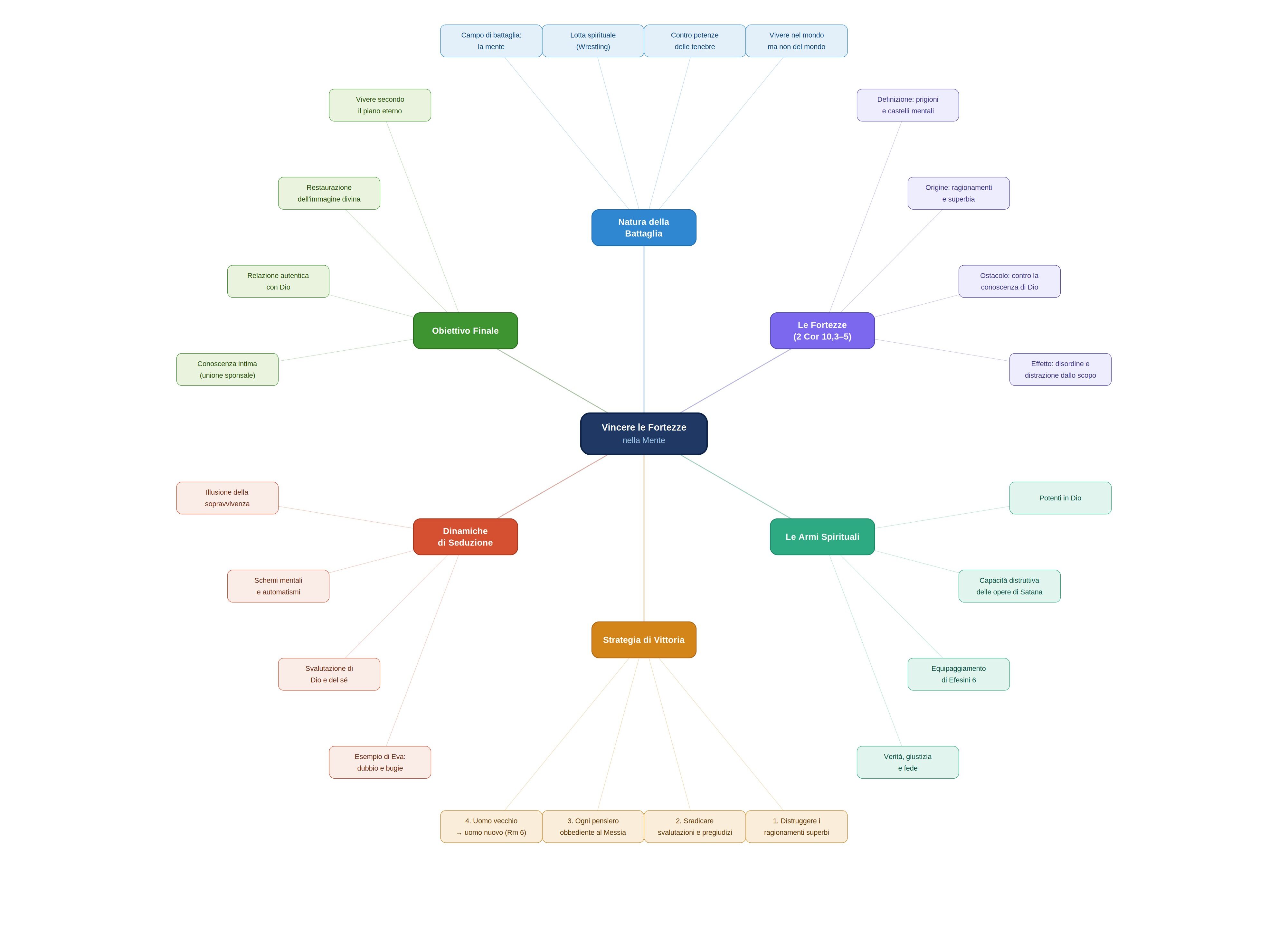
Mind map for Lesson 1
<div class=”breadcrumbs”><a class=”colored” href=”https://www.cantonuovo.org/” rel=”v:url”>← Home</a> /&<a class=”colored” href=”https://www.cantonuovo.org/formazione/” rel=”v:url”>TRAINING</a> / <a class=”colored” href=”https://www.cantonuovo.org/formazione/video-corsi/” rel=”v:url”>Video Courses</a> / <a class=”colored” href=”https://www.cantonuovo.org/formazione/video-corsi/la-battaglia-nella-mente-video-corso/” rel=”v:url”>The Battle in the Mind</a> /&<span class=”current”>LESSON ONE</span></div>
<!– .breadcrumbs –>