Recorded in Siena – 2013
Lecture 2 notes
THE BATTLE IN THE MIND
Cantonuovo Foundation · Maurizio Tiezzi
Lesson 2
Beliefs and blackmail
Key references: 2 Corinthians 10:3–5 · Ephesians 6:12 · Romans 6
1. The battle is in the mind
The title of the series is deliberate: The battle in the mind. The battlefield is the believer’s mind — it is there that prideful thoughts arise, where strongholds are built and fortified, and where convictions and behaviours take shape that lead us away from the Word of God and from the path He has prepared for each of us.
There is a specific reason for choosing this starting point: people tend to look for change outside themselves. We would like our children, colleagues and systems to change. Those who pray to change others set in motion forces that the Holy Spirit — who never compels anyone — does not govern. By starting with ourselves, however, we open ourselves to the possibility that everything else might change. The call is direct: to look at ourselves, to recognise what applies to us in what is said, to be open to seeing something we do not like, to decide to change our way of thinking and thus the object of our faith. This is the fundamental aim of the entire series.
The scriptural foundation is the one already established: Ephesians 6:12 — the struggle against the hierarchically organised powers of darkness — and 2 Corinthians 10:3–5, with spiritual weapons capable of destroying strongholds, the haughty arguments that rise up against the knowledge of God. In this lesson, we explore the concrete mechanism by which those strongholds are formed and operate in a person’s life.
2. The case of Adam
The following case is real, presented under a fictitious name: Adam. To look at it is to recognise oneself — at least in part — because the mechanism it describes, in various forms, is part of many people’s experience.
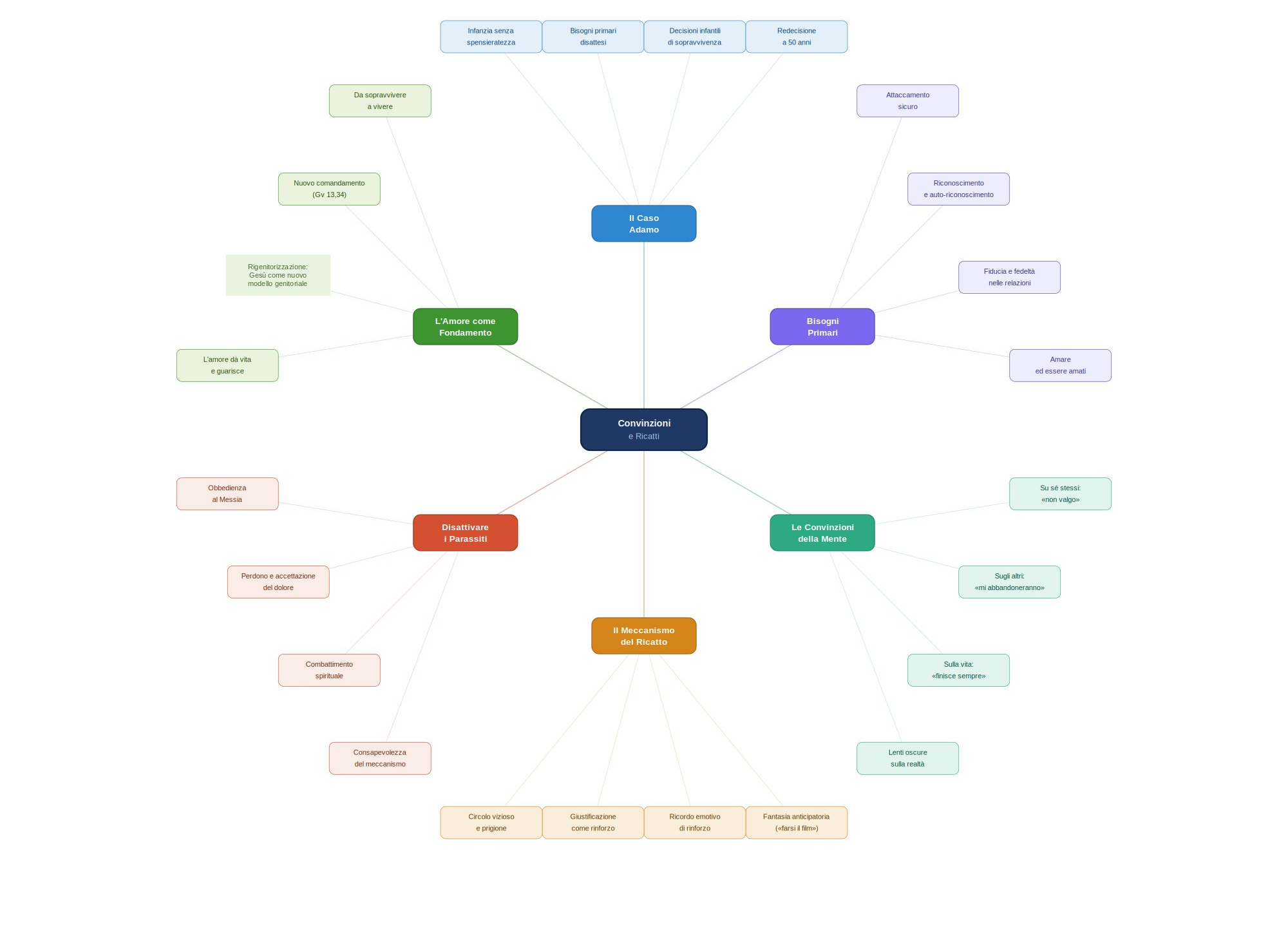
2.1 Childhood
Adam is the son of immigrants. The family moved abroad, where from a very young age he was entrusted (or so little Adamo perceived it) with the care of his younger siblings, because his parents worked and needed someone to look after them. Adamo recalls images of his father and mother getting ready to go out in the morning and telling him to look after the little ones. He experiences this as the natural order of family life — he chooses it, because he senses that it is the way to maintain his parents’ favour, to be recognised, to matter. His childhood passes without play, without carefree moments, without the fulfilment of those basic needs that every child should find.
At the age of six, his parents sent him back to his homeland with his grandmother and brothers, promising to join him soon. The promise was not kept: Adamo would not see his parents again until he was twelve or thirteen. During that time, he continued to look after his brothers, in a different country, without parental figures nearby. When asked ‘how did you feel when you saw them again?’, he replies ‘nothing’ — a word that carries the weight of years of pain.
2.2 The words of the story
Certain significant words recur in Adamo’s story: responsibility, protection of the younger ones, betrayal, pain, detachment. The separation at the age of six, the absence for another six years, the responsibility for raising his siblings — all this is experienced as a betrayal by his parents. Yet his parents did not intend to betray him: they were providing for the family as best they could. There is always a gap between what someone does and what we perceive, especially when we are young; and that perception — not the objective truth of the situation — is what shapes our beliefs and moulds our future choices.
This is a fundamental point: many attribute the absolute truth of the situation to their own thoughts, and this has very serious consequences. Adam’s perception was true for him; it was not the reality of what his parents intended.
2.3 Primary needs
Among the primary needs of every human being, two stand out. The first is secure attachment: the need to be able to trust one’s caregivers wholeheartedly and to reciprocate that loyalty and trust within the loving relationship. The second is recognition and self-recognition: to be seen as people who exist, think, feel emotions and make decisions; and to know oneself for who one truly is, beyond what the environment demands.
Modern psychology has recognised these two needs as fundamental. Yet Jesus had already pointed them out two thousand years earlier: ‘love one another’ is the very root of all sound pedagogy. In Adam’s case, both needs remained unmet, through no one’s conscious fault, because that is simply how things had turned out.
2.4 Childhood decisions
Faced with an insecure attachment — parents present today and absent tomorrow, unpredictable — Adam develops certain responses. These are intuitive responses for survival: the best way a child can find to avoid emotional death, to feel recognised as existing.
First decision: since being with others causes pain, it is better to keep them at a distance. From this root springs the systematic detachment from every relationship the moment it becomes intimate.
Second decision: to give one’s best according to what others ask for — because only in this way does one earn acceptance and recognition.
These two decisions produce a fundamental conviction that Adamo only clearly recognises at the age of fifty: receiving love is dangerous, because the more one becomes attached, the greater the pain will be when the relationship ends — and it always ends. Better to break it off first. The justification he uses to sugar-coat the mechanism is that at least this way the other person suffers less. It is the sugar that makes the bitter pill palatable, the way we describe our own prison so as not to feel entirely imprisoned.
2.5 The re-decision
The turning point comes when, during the conversation, Adamo pauses and realises he has always spoken of giving love, without ever mentioning receiving it. He bursts into tears. In those tears he recognises the void of fifty years — what he had buried as a child resurfaces and this time is not avoided.
The redecision he makes is concrete: to forgive his parents, because he has understood that he made the choices, not others for him — when one decides to live in complacency to be accepted, the choice is one’s own, even if no one has put it in those terms. To reconcile with his father, with whom he has not spoken for thirty-two years. To learn to recognise and accept himself, starting with the child he had cast aside. ‘I want to start again from where I left off,’ he says — and it is one of the most important statements he could make.
3. The parasites of the mind and beliefs
3.1 How beliefs are formed
Adam’s story illustrates a universal mechanism. Childhood decisions are survival strategies adopted in response to situations of danger or unresolved pain — ways of burying unbearable emotion or fear and moving on. These strategies are tried out, reinforced and refined over time. When situations similar to the original ones arise again, the same strategy is reactivated as if no time had passed.
By default, the brain continues to propose the same thoughts and produce those same emotions. Chemistry and electricity are activated, synapses are strengthened and beliefs take root, confirming that “that’s exactly how it is, just as you’ve always thought”.
Childhood conclusions, experienced in the present as if they were current, become beliefs: stabilised mental structures regarding oneself, others and life. A belief functions like a pair of dark glasses over the eyes — one does not see the present reality for what it is, but experiences the current situation as one has experienced it ever since, with the same strategy, only more refined, because over fifty years it becomes perfected.
In Adam’s case: regarding himself, he was convinced he was worthless and unworthy of love; regarding others, that they would betray him; regarding life, that relationships always end. And he believed it with all the faith he had!
Beliefs as acts of pride |
We said it in the first lesson: any thought that devalues oneself, other people or situations is a proud thought. It is worth understanding why. God created man in his own image and likeness, entrusted him with creation to manage according to divine wisdom, and crowned him with glory and honour (Ps 8). Anyone who is convinced that they are worthless ‘unless they do what others want’ is placing their own judgement above that of God — and this, even when it manifests as humility or self-deprecation, is pride. |
Beliefs that devalue us are therefore strongholds to be torn down. They contradict God’s view of the person. |
3.2 The parasites of the mind
Such deeply rooted beliefs function like parasites: they attach themselves to the person, suck away every chance of them being themselves and offer them, in return, the illusion of being accepted, provided they trade their true nature for what their environment demands.
The parasitic mechanism operates through four main components.
Anticipatory imagination — ‘playing out the scenario’. When a conviction takes hold, the imagination is hijacked and produces the same scenario over and over until the end. Imagination is in itself a gift from God; but here the script is already written and the outcome is always that predicted by the old strategy. Adam already knows how it will go: he will be left to toil alone to earn recognition.
The reinforcing emotional memory. Along with the conviction comes the corresponding emotional memory — the anger, the pain, the fear of that time. An emotional elastic that pulls you back to the original situation as if it were happening now. That memory acts as proof: ‘see, that’s exactly how it is’. The person feels the same emotions, and those emotions validate the belief.
Justification as reinforcement. The explanations we give ourselves for the choice imposed by the conviction also become reinforcement: they make it morally acceptable, stabilise it, and make it harder to abandon. ‘It’s better if I end it first, so I cause her less pain’ — this is not generosity: it is the way in which the conviction preserves itself by presenting itself as a virtue.
Loyalty to the conviction. It is a matter of faith, understood as loyalty to one’s habitual way of thinking. If we remain loyal to our self-deprecating thoughts, we will see through to the end the story we have written for ourselves, in this case as authors of our own destiny.
4. The mechanism of blackmail
The four elements are linked in a vicious circle — a blackmail.
The reinforcing emotional memory triggers the belief. The belief triggers the suppressed emotion. The suppressed emotion confirms the need to trigger and reinforce the beliefs that were adopted to avoid it. The reconfirmed belief feeds the memory. The circle closes, sealed by the need to remain faithful to it in order to obtain what we have decided life has in store for us.
The cycle of blackmail |
Reinforcing emotional memory → activates the belief |
Belief activated → activates the suppressed emotion |
Suppressed emotion → confirms the need for conviction |
Conviction reconfirmed → reinforces the emotional memory |
— The circle is closed by faith. An impregnable prison. |
Those within this circle experience a situation that does not exist as such in the present, but which the person recreates so that the old strategy can be applied. The territory is safe — even if it is a prison — because it is the only territory known. For Adamo, detaching himself from others so as to feel nothing was his only certainty in a world of unpredictable relationships. Over fifty years, that strategy had become so automatic that he applied it without understanding why.
4.1 The demonic work
The mechanism of parasites and blackmail bears the mark of the enemy. For the forces of darkness, it is enough to jam the gears of love in one generation to cause damage in the next three or four. Family dynamics, blocks passed down from parent to child, repeated emotional blackmail: this is where the battle of Ephesians 6:12 CAN take concrete form in everyday life, and the struggle of 2 Cor. 10:3–5 becomes inevitable.
The devil can also plant thoughts in the mind — thoughts that continually reinforce existing beliefs to increasingly challenge our faith. The emotional triggers that bring us back to the original pain as if it were happening now are not merely psychological dynamics: they are also a demonic work that exploits the structure of the human brain as a tool. This is why the battle requires both tearing down strongholds and making thoughts obedient to the Messiah — one cannot stand without the other.
5. Deactivating the parasites: the way out
5.1 Spiritual combat
The first step is awareness: recognising the mechanism, seeing the belief for what it is. Without awareness, there is no choice. Awareness alone, however, is not enough. Knowing how the mechanism works without being able to free oneself from it is of little use — it improves one’s understanding of the problem without eliminating it.
The second step is spiritual warfare: weakening the parasites with the weapons of God (2 Cor 10:4), changing the thoughts on which to place one’s faith. Spiritual action — prayer and thinking according to Phil. 4:8 — has a deactivating power that psychological techniques, even the most sophisticated, cannot replace.
5.2 Obedience to the Messiah
Breaking down strongholds without making thoughts obedient to the Messiah leaves the field open: the strongholds are rebuilt. This is the secret of 2 Corinthians 10:5: the three steps — destroying arrogant reasoning, uprooting devaluing thoughts, and bringing every thought into obedience — are inseparable. The believer who fights spiritually but does not live in obedience to the Messiah will find themselves, at the first opportunity, once again under blackmail, with the parasites active once more and the devaluing beliefs on the march again.
Bringing thoughts into obedience to the Messiah means recognising him as Lord and thinking as he would think, so as to do his will in every situation life presents. The mind begins to be renewed. Paul says to learn to be renewed in the spirit of our minds (Eph 4:23) and to “be transformed by the renewal of our minds”.
The mind is not the brain. The latter is a physical organ. The mind is the soul that can direct the brain. It is possible to decide what to think (self-control — a fruit of the Holy Spirit). All that is needed is for the soul to decide to conform to God’s thoughts, first and foremost regarding ourselves. The brain, which is plastic, can follow and change.
Jesus, as John the Baptist had already said at the beginning of his public ministry, proclaims: “Repent, for the kingdom of God is near’.
The old nature is not improved: it is taken up to the cross (Romans 6) and deactivated. What is born is new and subject to transformation. The body (brain) follows and will in due course be transformed.
5.3 Re-parenting
The process of inner transformation involves re-parenting: replacing parental references — the verbal and non-verbal messages that shaped childhood decisions — with the values and thoughts that God offers, moving from choices of survival to choices of life.
Jesus is the Parent who does not abandon, does not betray, and is not unpredictable. ‘Behold, I am with you always, even to the end of the age’ (Mt 28:20). The Holy Spirit is the ‘other Advocate/Helper’ promised ‘so that he may always be with you’ (Jn 14:16). The relationship with Jesus offers what insecure attachment could not provide: absolute fidelity, constant presence, and love that never fails. Secure attachment finds its ultimate object here.
The process of deactivating parasites |
1. Awareness: recognising the mechanism of belief and its vicious circle |
2. Spiritual combat: weakening the parasites with the weapons of God (2 Cor 10:4) |
3. Forgiveness and acceptance of pain: one cannot become immune to pain; one can accept it |
4. Obedience to the Messiah: bringing every thought into subjection to Christ (2 Cor 10:5) |
5. Re-parenting: replacing old parental references with God as Father |
6. Love as the foundation
The underlying problem in every mental stronghold is, at its root, a block on love. When that mechanism jams in one generation, survival strategies take the place of life; and the damage is passed on. It is impossible to deactivate the parasites without filling the space left behind with love.
‘Love is what gives life, love is what sustains it, love is what heals.’ With these words, the conversation ends. Then they look at each other, embrace, and Adamo bursts into tears.
The new commandment — ‘love one another as I have loved you’ (Jn 13:34) — is not an ethical imperative imposed from outside: it is the law that governs life and its fullness. The believer’s new mind is not a mind emptied of old convictions: it is a mind inhabited by the presence of Jesus.
Adam, in the end, says: ‘Now it’s my turn’. He has looked after his brothers, he has done his duty, he has lived for fifty years in the service of others. He has decided to be himself. That is not selfishness: it is the recognition that only those who are free to receive love are truly able to give it.
Notes on the text
Handout based on the transcript of the lecture of 27 March 2013. The ‘Adamo’ case is a real counselling case, presented under a fictitious name. The handout contains only the material presented in the lecture, with some additions made posthumously by the author.
Mind map for Lesson 2