Recorded in Siena – 2013
Lecture 3 notes
THE BATTLE IN THE MIND
Lesson 3
Renewal
Cantonuovo Foundation · Maurizio Tiezzi
1. The foundation: the Cross and free will
There is a message we must not lose sight of whilst speaking of strongholds, orders and convictions: the Lord has secured our liberation through his death and resurrection. God had “placed” each of us in Him; since He died in our stead and with us, every person descended from Adam according to the flesh had been placed by God in Jesus, so that when Jesus died, all those who identified with Him by faith died to sin. By rising again, He offered new life to all who believed in Him. The fact is accomplished.
This truth, however, does not mean that our subsequent response is irrelevant. There are those who think that since Jesus has already done everything, the way we live is of no consequence. This is not what the Lord has told us and set us to do. He said: “Do what I tell you.” He said that unless we deny ourselves, we cannot be His disciples. That death is real for us today — two thousand years later — and I experience it to the extent that I apply it to my life. The life I live matters, but it depends on the death to which I have already died.
Renewing the mind is exactly this: wanting to experience in our lives what Jesus has already accomplished. If everything were already accomplished without our free, voluntary, conscious acceptance, it would be an imposition. That is why we are called by Jesus to deny ourselves — to no longer desire that old nature, which is now dead. It is the old nature that sins, but if it is dead, it can no longer sin, unless we bring it back to life by choosing to follow the world. The novelty of the Lord’s work is this: those who embrace it by conforming their lives to the will of Jesus can live by His life of resurrection.
2. Demolishing and building: two inseparable movements
The theme of this lesson is renewal. The Bible invites us to renew our minds because, if with our minds we do not adhere to God’s plan — to His will, which we receive in our spirit — we are as though divided: our inner man receives the light, but if the brain remains turned towards darkness, we do not see where we are going.
I want to return to Jeremiah 1:10 in relation to 2 Corinthians 10:3–5. I have already said several times that we are not called merely to destroy the strongholds and the haughty reasoning of our minds: we are also called to bring them into submission to the Messiah. I repeat this, because I think it is useful.
Jeremiah 1:10 |
“Behold, today I give you authority over the nations and over the kingdoms to uproot and to tear down, to destroy and to overthrow, to build and to plant.” |
On the one hand, God speaks of destruction; on the other, of building. If a person focuses solely on destroying the strongholds of the mind, but then does not submit their thoughts to the Messiah, that destruction may last for a time, but then the strongholds will reform. If you are not aligned with the thoughts of the Lord Jesus by making them your own, you align yourself with the mindset of the world (by placing faith in the old way of thinking that the brain proposes by default). Knowing from Jesus that the prince of this world is the devil, without changing you risk following his twisted ways, consciously or otherwise. Merely destroying without rebuilding makes no sense.
But rebuilding does not mean undergoing psychotherapy. However much I devote myself to the sciences of the mind (transactional analysis in particular) , that is not what can rebuild according to God’s will. Rebuilding means knowing, through the Word of God, His thoughts and ways, thinking them as our own and living them. The bricks for building God’s holy temple — which is us — are His Word, thought, believed and then acted upon, not other reasoning.
There is also the reverse movement, which is just as dangerous: those who, believing in the Lord Jesus, enthusiastically plunge into submitting their thoughts to the Messiah without first going through the process of demolition, risk carrying their old mental baggage with them, mix things up and end up returning to the old ways. The two actions must be done together; they must be done together.
3. The strong man in the stronghold
Since we are speaking of strongholds — of structures built to protect something which, being proud, rises up to prevent the knowledge of God — within these strongholds that are in our minds there is a strong man. Listen: to destroy a man, it is not necessary to kill him physically. To destroy a man, it is enough—even unconsciously—through the family, the environment, the events of life and unknown forces—to lead him away from his destiny. A single deviation is enough.
When a person, from a very young age—indeed, from the moment of conception—is led to deviate from their destiny—and destiny is God’s plan for that person in every moment of their life, not just the final destination—it is enough for the devil, by placing his strong men in people’s minds, manages to lead them astray by inducing them to plan a different story: that person is destroyed.
According to God’s plan, we are called to bear the image of God, to represent Him on earth and to live in glory. Not only after death, but from this moment onwards. The Kingdom has been restored and is among us, from this moment onwards. Those who do not realise this have failed to understand that there is someone who does not want them to live out their destiny. This is precisely where we must intervene.
Luke 11:21–22 |
”When a strong man, fully armed for battle, guards his own house, his possessions are safe. But when someone stronger than him attacks and defeats him, he takes away all the armour and weapons he relied on and divides the spoils.” |
The ‘possessions’ that the strong man guards are the rubbish he has created in our minds: all our wrong decisions, false beliefs, the lies we have swallowed, the life plans built solely to try to survive since childhood. He guards them because he is well-armed.
But this strong man is not the strongest. There is one stronger than him — Jesus was speaking of himself in relation to the devil and his demons, saying that He is stronger. When He comes, He defeats him, destroys him, and the victory is total: when the spoils of the vanquished are distributed, it means that the victory has been total, that we have taken everything that had been defended.
Luke 11:23 |
”Whoever is not with Me is against Me; and whoever does not gather with Me scatters.” |
Many maintain that, whilst living in religiosity and legalism—not being against God, but living their lives according to the old nature—they are nonetheless with Jesus. I have my doubts. Jesus is clear: either with Me or against Me. If you are not with Me, you scatter; if you are with Me, you gather with Me. All religious activities carried out outside this fellowship come to nothing.
4. The house filled with the Spirit
Luke 11:24–26 |
”When an unclean spirit comes out of a person, it wanders through arid places seeking rest, and finding none, it says: ‘I will return to my house from which I came. On returning, it finds the house swept and put in order. Then it goes and takes with it seven other spirits more wicked than itself, and they enter and dwell there, and the final condition of that person becomes worse than the first.” |
This is the secret. When Jesus comes and overcomes the strong man, he drives him out; the demons are cast out in his name. But when the demon is cast out, he wants to return to the place from which he was sent away. If the house is swept and made ready, but not filled, it is ready for the return of eight strong men. That is why it is not enough to demolish the strongholds, defeat him and destroy him. It is not enough to understand the workings of the mind and make a fresh decision. Human therapy alone is not enough: to be truly solid, every ‘space’ within us must be filled by the Holy Spirit.
I challenge anyone who has gone through only demolition and human therapy to say that this was enough in their life.
Ephesians 5:18 |
”…be continually filled with the Spirit” |
If the house is filled with the Spirit, no one can enter it again. That is why, when we pray for deliverance, we cast out demons and then ask the Holy Spirit to come and fill this person, to fill all the empty spaces left by these demons who have departed, so that, even if they return, they find them occupied by Him and cannot return. It is a prayer in which the person voluntarily submits to Jesus and asks to be filled by Him so that they may then live for Him, doing His will.
5. The case of Pietro
I want to talk about another specific case. There is no real Pietro: it is a made-up name, just as Adam was last time.
Pietro worked tirelessly and worked hard all day long. He was always busy and, if what he was doing wasn’t enough, he would invent other things: almost strangely, new tasks always seemed to come his way. He thought he couldn’t escape them, but in reality, without realising it, it was he himself who, when they came along, welcomed them with open arms because they allowed him to respond to an inner urge he felt:
”Push yourself, give it your all, try to please the people who expect you to work hard, to do your duty. Hurry up, get a move on, quickly.”
These commands he heard within himself were inner urges that unconsciously led him to act accordingly. Speaking at length with Pietro, it emerged that these things had always been said to him by his parents and relatives, and that he saw them put into practice in his parents’ own lives. On the one hand he heard it said, on the other he saw it done. As a child he had concluded that this was the only possible way to please his parents and have a place in the family.
Yet, faced with these urges that produced constant fatigue and anger, he reached a point of maximum exertion where he felt a counter-urge: no longer “do, do, do’, but a sense of total futility. Inside, he had a stop sign, a prohibition: do not relax, do not be intimate with people, do not form bonds, do not trust the world. And despite all his efforts, he found himself facing a black hole that told him: “You are destined never to feel joy, you are destined never to relax, you are destined never to see relationships through to the end because they’ll leave you anyway.”
This vortex drew him back into a sense of futility regarding everything he did. Once there, he could have two reactions: either to cloak himself in sadness and frustration, or — before embracing that feeling — to blame others for what had happened to him, playing the ‘it’s all your fault’ game. The two positions alternated. And once he reached the point of anger and frustration, the conviction would kick in: ‘Try again! You see, it’s true that you can’t enjoy what you’re doing, but perhaps you haven’t tried hard enough yet.” And that was the impetus for him to start working hard all over again.
Look at this vicious circle: it was continuous, repetitive, and could occur within ten minutes just as easily as it could recur over the years. The person could not escape because there were magnets, as it were, drawing him in. Inside him was a strong man who had led him to form specific beliefs: there was no security in relationships, he could not receive love from others, he would not survive under that level of stress.
Pietro’s situation is more common than one might think, except that it occurs on an unconscious level — due to decisions made as children, orders conveyed verbally by parents or parental figures, and unspoken but enforced prohibitions and restrictions. On this basis, the person began to form beliefs about themselves, others and life; and those beliefs, increasingly reinforced, led them to conclude that the only way to live is to devise a life plan in which their beliefs are always confirmed. |
6. Inner commands
There are messages that parents — and other parental figures: grandparents, uncles and aunts, tutors, teachers — convey to children, both verbally and through their example. Children ‘soak them up’ when they are young, nurture them as they grow up, and then pass them on to subsequent generations. This is not merely a matter of psychological transmission: this stuff is driven by an evil force that accompanies them from generation to generation.
Here are the main commands:
- Be perfect. Perfectionism is a scourge because it is an impossible commandment to fulfil. Perfectionism serves the purpose of gaining acceptance: since you cannot be perfect, sooner or later you will make a mistake and destroy yourself or others.
- Be strong. Sometimes translated as ‘men don’t cry’, the underlying prohibition is: do not feel. And when there is a prohibition on feeling, the person is incomplete.
- Strive. Performance as a permanent condition of existence.
- Try to please. People-pleasing is a scourge: it leads to earning the right to exist through favours and manipulation, trading one’s own nature for what the environment demands. Many people please others just to be accepted into their company, simply to be able to say ‘I’m here.’
- Hurry up. Urgency as the normal state of life.
- Work hard. A person’s worth measured by the amount of effort expended.
- Be careful. Repeated constantly: it instils in the person a permanent perception of a dangerous world.
7. The beliefs of the life plan
In addition to commands, there are beliefs, and these concern survival. A belief about ourselves can be defined as a false belief if it stems from a prohibition. That is to say: ‘do not feel’ is a prohibition. If a person has been forbidden not to feel and has somehow internalised this, they will become convinced that they cannot feel. When these deep-seated prohibitions become a belief, they construct within the person a life plan that is not their own but which seems to them the best way to survive in the context in which they found themselves.
Faced with a prohibition, a person can react in two ways: with defiance — the active and ostentatious response — or with despair — the resigned and passive response. Both positions are survival responses, not choices of a free life. Beliefs form around five existential areas: survival, identity, attachment, competence, security.
Survival
- Not existing: ”I will show that I am here” (defiance) / “I am wrong, there is no place for me” (despair). Many people face life knowing deep down that they do not exist; it is as if they were not there. God did not send them to this earth to be desperate about their existence.
- Not being important: ”I will be greater, greater than life itself” (challenge) / “I am afraid, I don’t care about anything” (despair). If a person knows they are not important, they will never fulfil the task God has given them.
- Not feeling well / not looking after yourself: ”I must be strong, I have no time for myself” (challenge) / “Nobody pays attention to me: if I fall ill, perhaps someone will look after me” (despair). Jesus tells us to love ourselves in order to love our neighbour, but these people cannot do so because it is forbidden to them.
- Not trusting: ”I only trust myself” (challenge) / “I am paralysed by fear; you cannot trust the world” (despair). How many people do you know who trust no one because they are paralysed by fear?
- Not being healthy: ”I’ll be perfectly normal, I won’t need anything” (challenge) / “There’s no help in the world” (despair).
Identity
- Not being yourself: ”I’ll pretend to be your ideal” (defiance) / “Whatever I do, you don’t like me” (despair). A life with a split or confused identity.
- Do nothing / don’t get involved: “I won’t do certain things until I feel better” — the person who will never start anything — (defiance) / “Deep down, I’m comfortable” (despair).
- Don’t separate: “I’ll be whatever you want, I’ll make you feel good” (defiance) / “I have no personality” (despair).
- Don’t be visible: “I’ll hide myself, I won’t show my vulnerability” (defiance) / “I’m ashamed of myself or my family” (despair).
Attachment
- Don’t be small: “I don’t need anyone” (defiance) / “No one can help me” (despair). This is the problem of attachment: he will never be sure of others’ love for him and will never be sure that he can love others. This is the case with Adam, whom we spoke of last time.
- Not belonging: ”I don’t care if nobody likes me” (defiance) / “I can’t show how much I care about the other person” (despair). Wherever you go, whoever you’re with, you never feel part of anything. This is often accompanied by “not being intimate”.
- Not being intimate: ”I’ll wait and find the perfect relationship” — but it will never happen — (defiance) / “I’ll be abandoned again” (despair). This is the mockery of a life lived in the repetitiveness of a destiny that is not our own.
- Don’t get attached: “I’ll get what I want from the other person” — manipulation — (challenge) / “I don’t exist” (despair).
- Don’t want: ”I’ll never want anything, I’ll eliminate the problem” (defiance) / “I try to please without succeeding” (despair). This concerns the passivity of the will.
Competence
- Not growing up: ”I’ll do things my way; I’ll create my own world” (challenge) / “I’ll go it alone but I don’t know what to do” (despair). It is the eternal child — a scourge that is rampant in Italy.
- Failure: ”I must prove myself in every field” (challenge) / “I am a complete failure” (despair). How often have we prayed to drive the spirit of failure from people! Fortitude is “not succeeding” and within it there is a strong man who occupies it firmly.
- Not thinking: ”I will impose my will on others and on the whole world” (challenge) / “I’m not very intelligent” (despair).
- Failure: ”I must take care of everyone and everything” (challenge) / “I always feel reproached” (despair). In stark contrast to Psalm 1: “and everything he does prospers.”
Security
- Not feeling: ”I don’t care about anything” (challenge) / “I cannot show how much I care” (despair).
- Do not rejoice: ”I must always do more” (challenge) / “I feel empty” (despair). This is the case with Pietro: all his life he strove to work hard, but he reached the end knowing that he would not enjoy the fruits of his labour.
- Do not be ungrateful: ”I deserve more” (challenge) / “I have nothing” (despair).
- Not relaxing: ”I must be vigilant to prevent bad things from happening” (challenge) / “I am overwhelmed by things” (despair).
If you recognise yourself in any of this, it is worth reflecting on it: these are the strongholds we harbour within. The strong man who has taken up residence in our minds from the very beginning has led us to choose — and this is the irony — a destiny that is not the one God intended for us. And however religious a person may be, with these convictions they will never find peace.
8. God as a new frame of reference
God has always offered His people His fatherhood: care, attention, providence, protection, fatherly teaching. That guidance of the people of Israel, and now of all believers in Christ, has been a process of re-education to think differently about themselves, others and life, through a figure of reference — Him — different from the one from whom they had drawn false beliefs.
Jesus came to do exactly this. He destroyed false beliefs about man by showing us what the true man according to God is like — He was that man. He destroyed the old man on the cross, rose again as a new man, and presented him to the Father. The Father sees all of us, His disciples, in Him as though we had never sinned, and He says to us: ‘Now live as Jesus lived, as He showed you.’
Submitting one’s thoughts to the Messiah means changing one’s thoughts, values and points of reference: moving from choices of survival to choices of life. God is the Parent who does not betray, does not abandon, and is not unpredictable. “Abba” also means “beginning”: that is where we start again.
Success and prosperity in God’s sense |
I propose that “Success” means carrying out the task for which we were created. That ‘Prosperity’ means cooperating with God so that the things God Himself has planned may come to pass—not in a minimal way, but in fullness. God created every man so that he might rule over and subdue the earth according to His plan, bringing order out of chaos. No one was created for despair, for failure or for a lack of joy. Someone has pushed in that direction: and that guest can be cast out. |
─
The call is not to tolerate a life in the condition of Adam or Peter. Let us tear down false beliefs, cast out that strong man — who is, however, weaker than the Spirit of God living within us — and rebuild the ancient ruins according to the model of Jesus, who, having risen, sits at the right hand of the Father. His Kingdom is already among us, we are part of it as his ambassadors on this earth and we are called to proclaim it to all.
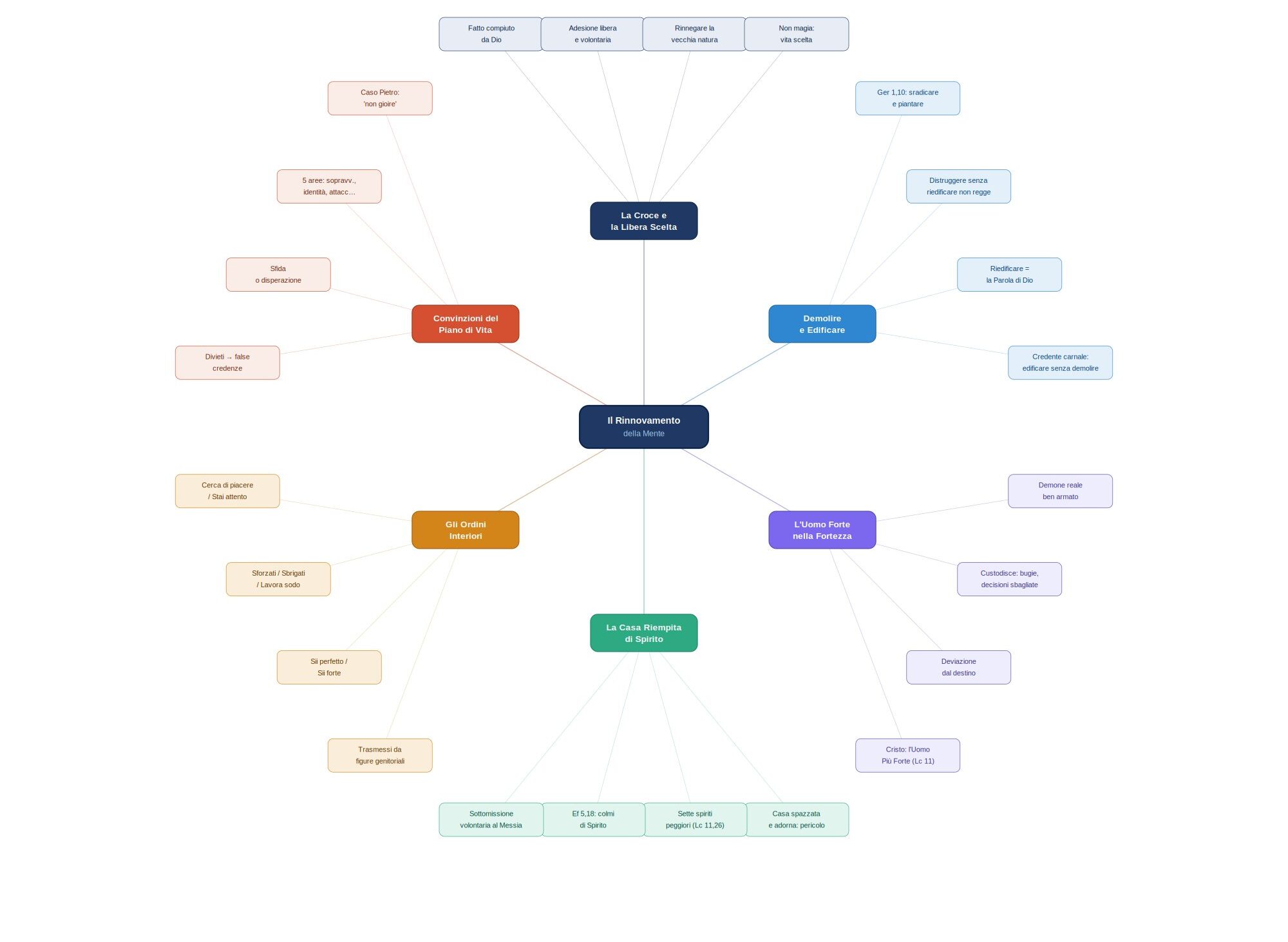
Mind map for Lesson 3